
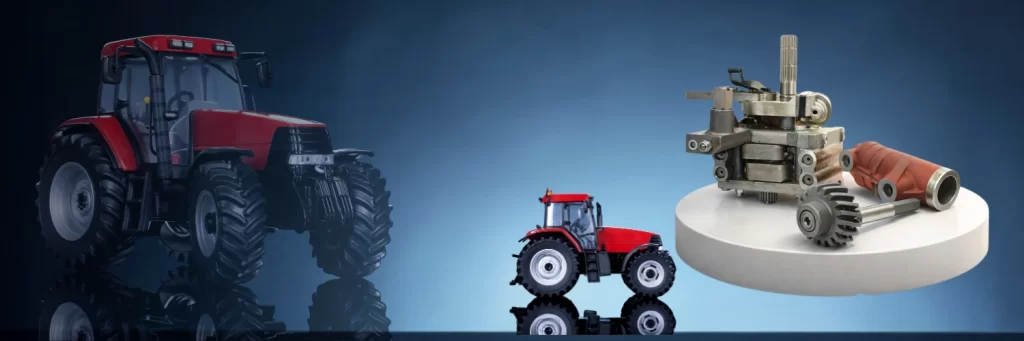
Brazil has one of the largest tractor fleets in Latin America. These machines work daily in soybean, corn, sugarcane, coffee, cotton, and various other agricultural fields. Because they operate for long hours and in harsh conditions, component replacement is part of routine maintenance.
For distributors, importers, resellers, and agribusiness companies, finding a reliable tractor parts distributor goes far beyond comparing prices. The decision directly influences equipment availability, customer satisfaction, and business profitability.
A part manufactured with low precision can cause accelerated wear on other components, increase machine downtime, and generate maintenance costs far exceeding the savings from the purchase. For this reason, experienced companies analyze the entire supply chain before choosing a business partner.
In this guide, you will understand what criteria truly differentiate a specialized distributor, what technical aspects should be evaluated before purchasing, and how to identify a supplier prepared to serve the Brazilian market.
What truly makes a tractor parts distributor trustworthy?
Not every company that sells agricultural parts has the infrastructure to serve distributors or importers.
A reliable distributor typically possesses four fundamental characteristics:
- extensive product portfolio
- strict quality control
- continuous supply capability
- specialized technical support
These factors work together. There’s no point in offering hundreds of items if the company can’t maintain consistent manufacturing standards or meet delivery deadlines.
For those who buy regularly, stability of supply is just as important as quality.
Before choosing a supplier, understand your company’s profile.
The first step is to define exactly how the pieces will be used.
A specialized workshop has different needs than an importer.
Similarly, a regional distributor typically works with different volumes than those negotiated by large wholesalers.
Some questions can help in this process:
- Do you buy to resell?
- Do you need to import in large quantities?
- Does it fit different tractor brands?
- Do you work with preventive or corrective maintenance?
- Do your customers require prompt delivery?
Answering these questions makes it easier to choose a tractor parts distributor that can keep up with the growth of your operation.
Why does the quality of the parts have a much greater influence than maintenance?
When a part fails, the damage is rarely limited to just the replaced component.
Imagine a hydraulic pump manufactured with inadequate tolerances.
Even small variations during machining can reduce hydraulic system pressure, hindering the operation of the hydraulic lift and compromising agricultural implements used daily.
The same applies to transmission gears.
If the teeth are not machined correctly, uneven wear occurs, increasing noise and reducing the lifespan of the entire assembly.
Therefore, specialized companies don’t just analyze the appearance of the item.
They check:
- Dimensional accuracy
- mechanical strength
- quality of the material
- surface finish
- Compatibility between components
This assessment reduces future failures and improves equipment performance.
How to identify a distributor prepared to serve the Brazilian market?
There are several factors that differentiate professional suppliers from companies that only sell parts.
Extensive catalog
A specialized distributor typically offers solutions for different tractor systems.
This reduces the need to buy from multiple suppliers.
In addition, it facilitates inventory management and simplifies future replenishments.
Production capacity
A supplier needs to be prepared to handle both small and large volume orders.
This is especially important during periods of high agricultural demand, when distributors need to replenish stocks quickly.
Logistics planning
Another important point is the ability to organize deliveries in a consistent manner.
Well-structured companies work with defined processes to reduce delays and maintain greater predictability.
What parts should a specialized distributor offer?
A complete company doesn’t work with just a small group of components.
It must serve different mechanical systems of the tractor.
Hydraulic system
The hydraulic system is among the most demanding components during agricultural operations.
Among the main pieces are:
- hydraulic pumps
- hydraulic valves
- Lift cover
- Hydraulic control components
- hydraulic cylinders
- Power steering parts
These components need to withstand constant pressure during thousands of hours of operation.
Any excessive wear and tear can compromise the efficiency of the equipment.
Engine components
The engine houses several components subjected to high temperatures and continuous mechanical stress.
The most sought-after components include:
- pistons;
- shirts;
- connecting rods;
- rings;
- oil pumps;
- Water pumps;
- crankshafts;
- cylinder heads;
- valves;
- together.
The quality of these components directly influences the engine’s power, fuel consumption, and reliability.
transmission system
During agricultural work, the transmission receives constant loads from the engine.
A specialized distributor typically provides:
- gears;
- axes;
- distinguishing features;
- bearings;
- Gearbox components.
These parts need to exhibit excellent wear resistance to withstand intensive operations.
Steering system
The steering directly affects the safety and control of the equipment.
Among the most important components are:
- steering arms
- terminals
- bars
- spindles
- hydraulic steering components.
When manufactured correctly, these items provide greater precision while driving the tractor.
Compatibility also reduces costs.
A very common mistake is buying components without checking all the technical specifications.
Even visually similar parts can have dimensional differences that compromise their installation.
Therefore, a good tractor parts distributor offers clear information about compatibility.
Among the brands frequently served are:
For distributors, this represents a significant advantage, as it expands the number of customers served using a single supplier.
How does quality control reduce future problems?
Quality control doesn’t just mean checking the finished product.
Specialized companies oversee virtually every stage of manufacturing.
The process typically begins with the selection of raw materials.
Then, each component goes through machining, finishing, and inspection processes.
During these steps, checks such as the following may be performed:
- Dimensional Conference
- visual inspection;
- evaluation of the finish;
- assembly tests;
- Final inspection before packaging.
These procedures significantly reduce the risk of shipping components that do not meet specifications.
For distributors and importers, this means fewer returns, fewer complaints, and greater customer confidence.
Technical support is also part of quality.
A specialized distributor doesn’t just deliver products.
She also helps her clients identify compatible components, clarify technical questions, and select the best solutions for each application.
This support is especially important when distributors work with different tractor brands or need to locate specific components.
Having access to a technical team reduces purchasing errors, improves customer service, and strengthens business relationships.
The choice of supplier influences the company’s growth.
In the agricultural market, a good business partnership goes beyond simply supplying parts.
It helps to keep inventories organized, reduce delivery delays, and ensure that distributors can serve their customers quickly.
Companies that carefully choose their tractor parts distributor are able to operate with greater predictability, reduce operating costs, and build lasting business relationships.
In the next chapter , we will see how to compare domestic and international suppliers, understand the differences between OEM and aftermarket parts, evaluate export processes, and identify the mistakes that distributors and importers should avoid before closing a partnership.
How to Compare Tractor Parts Distributors Before Closing a Partnership
After identifying companies that serve your market, the next step is to evaluate which one can truly become a long-term partner. Many buyers focus their decision solely on the price of the parts, but this strategy rarely yields the best results.
A distributor of tractor parts must demonstrate the ability to supply consistent products, meet diverse demands, and keep pace with the growth of your business. When these factors are analyzed together, the choice ceases to be a simple purchase and becomes an investment in the stability of the operation.
How to compare suppliers strategically.
Before requesting a quote, prepare a list of criteria to compare different suppliers.
Analyze aspects such as:
Catalog variety;
quality of the components;
production capacity;
experience in the market;
Technical support;
delivery logistics;
Stock availability.
This assessment allows us to identify companies capable of fulfilling both occasional orders and ongoing supply contracts.
It’s also worth noting how the supplier responds to business requests. Organized companies usually provide clear technical information, answer questions quickly, and have well-defined business processes.
OEM parts and aftermarket parts: which option makes more sense?
When searching for a distributor, it’s common to find both OEM parts and aftermarket parts.
OEM parts are manufactured according to the specifications of the original equipment manufacturer.
Aftermarket parts, on the other hand, are manufactured by specialized companies to offer compatibility with different tractor models.
A quality aftermarket part doesn’t mean an inferior product. Specialized manufacturers invest in modern machining processes, dimensional inspection, and quality control to ensure performance and reliability.
Therefore, the decision should consider the manufacturer’s reputation, the quality of the materials used, and the consistency of the production process, and not just the part’s classification.
How manufacturing capacity influences supply.
For distributors and importers, understanding the supplier’s structure is just as important as evaluating the product.
A well-prepared company typically has the capacity to maintain continuous production and fulfill orders of varying volumes without compromising quality.
When evaluating a manufacturer or distributor, try to understand:
production capacity;
factory organization;
inspection processes;
production planning;
availability for new orders.
These factors reduce risks during periods of higher demand and provide greater predictability for market supply.
Logistics is also part of quality.
Mesmo uma peça fabricada com excelência pode perder valor se não chegar ao cliente dentro do prazo esperado ou em condições adequadas.
Uma distribuidora estruturada investe em processos logísticos que preservam os componentes durante o transporte e organizam o envio de maneira eficiente.
Entre os pontos que merecem atenção estão:
embalagens resistentes;
identificação correta das peças;
organização dos pedidos;
acompanhamento do processo de envio;
planejamento das entregas.
Uma logística bem executada reduz atrasos, evita danos aos produtos e melhora a experiência do cliente.
Como reduzir custos sem comprometer a qualidade
Economizar não significa escolher o menor preço.
O verdadeiro custo de uma peça deve considerar todo o seu ciclo de utilização.
Um componente de baixa qualidade pode exigir substituições frequentes, aumentar o tempo de máquina parada e gerar despesas adicionais com mão de obra e manutenção.
Já uma peça fabricada com materiais adequados e processos consistentes tende a apresentar maior durabilidade e desempenho.
Por isso, muitos distribuidores avaliam o custo total de operação em vez de analisar apenas o valor da compra.
Essa abordagem permite decisões mais inteligentes e reduz gastos no longo prazo.
Erros que distribuidores devem evitar
Durante o processo de compra, alguns erros podem comprometer toda a operação.
Escolher apenas pelo preço
O menor preço nem sempre representa o melhor negócio.
Componentes de baixa qualidade podem apresentar desgaste prematuro e aumentar os custos de manutenção.
Comprar sem verificar especificações
Mesmo peças destinadas ao mesmo modelo de trator podem possuir diferenças técnicas importantes.
Confirmar dimensões, aplicações e compatibilidade evita problemas durante a instalação.
Trabalhar com muitos fornecedores
Gerenciar diversos fornecedores pode aumentar a complexidade logística, dificultar o controle do estoque e reduzir o poder de negociação.
Sempre que possível, vale a pena concentrar as compras em uma empresa que ofereça um portfólio amplo e fornecimento consistente.
Ignorar a capacidade de atendimento
Uma distribuidora precisa acompanhar o crescimento da sua empresa.
Antes de fechar uma parceria, confirme se ela possui estrutura para atender volumes maiores no futuro.
Por que distribuidores procuram fornecedores internacionais?
Nos últimos anos, muitas empresas ampliaram sua busca por fornecedores internacionais para diversificar o abastecimento e ampliar o catálogo de produtos.
Um fabricante com experiência em exportação normalmente oferece:
grande variedade de componentes;
produção em larga escala;
processos padronizados;
controle de qualidade consistente;
atendimento a distribuidores de diferentes mercados.
Para empresas que trabalham com importação, esses fatores ajudam a construir uma cadeia de fornecimento mais estável.
Como uma parceria sólida beneficia seu negócio
Uma boa parceria comercial produz resultados que vão além da entrega de peças.
When there is trust between supplier and distributor, it becomes easier to plan inventory, serve new customers, and respond quickly to market changes.
Furthermore, a reliable supplier can support the company’s growth by offering new products, improved availability, and technical support whenever needed.
This relationship creates greater security for all stages of the operation.
Trends in the tractor parts market in Brazil
The modernization of agriculture continues to drive demand for replacement parts.
With machines working longer hours throughout the year, the need for preventive maintenance and replacement of wear parts also increases.
At the same time, distributors are looking for suppliers capable of offering consistent products, wide availability, and reliable deliveries.
These changes make it even more important to choose a tractor parts distributor that is prepared to meet the demands of today’s market.
How to make the final decision
Before starting a partnership, gather all the information obtained during the supplier evaluation.
Consider:
quality of the components
company experience
variety of products;
supply capacity
logistical organization
technical support
Commitment to the customer
When these criteria are analyzed together, it becomes easier to select a supplier that contributes to the company’s sustainable growth.
Conclusion
Choosing a tractor parts distributor is a decision that directly influences operational efficiency, equipment availability, and the competitiveness of your business.
More than just supplying components, a specialized company should offer consistent quality, production capacity, technical support, and a business relationship based on trust.
By carefully evaluating factors such as product catalog, manufacturing processes, quality control, logistics, and industry experience, distributors, importers, and resellers can reduce risks and build a more efficient supply chain.
Regardless of the size of your company, investing in a reliable supplier is a strategy to improve customer service, reduce operating costs, and strengthen your presence in the agricultural market.
Perguntas Frequentes
Avalie a qualidade das peças, a variedade do catálogo, a experiência da empresa, a capacidade de fornecimento, o suporte técnico e a organização logística antes de fechar qualquer parceria.
Sim, desde que sejam produzidas por fabricantes especializados e apresentem processos consistentes de fabricação e controle de qualidade.
Bombas hidráulicas, válvulas, componentes da transmissão, peças do motor, sistemas de direção e componentes do levante hidráulico estão entre os itens mais procurados para manutenção de tratores.
Check the supplier’s production capacity, quality control processes, logistics organization, parts compatibility, and experience in serving international distributors.
Uma parceria sólida facilita o planejamento de estoque, melhora a disponibilidade de produtos, reduz atrasos nas entregas e contribui para o crescimento sustentável do negócio.