
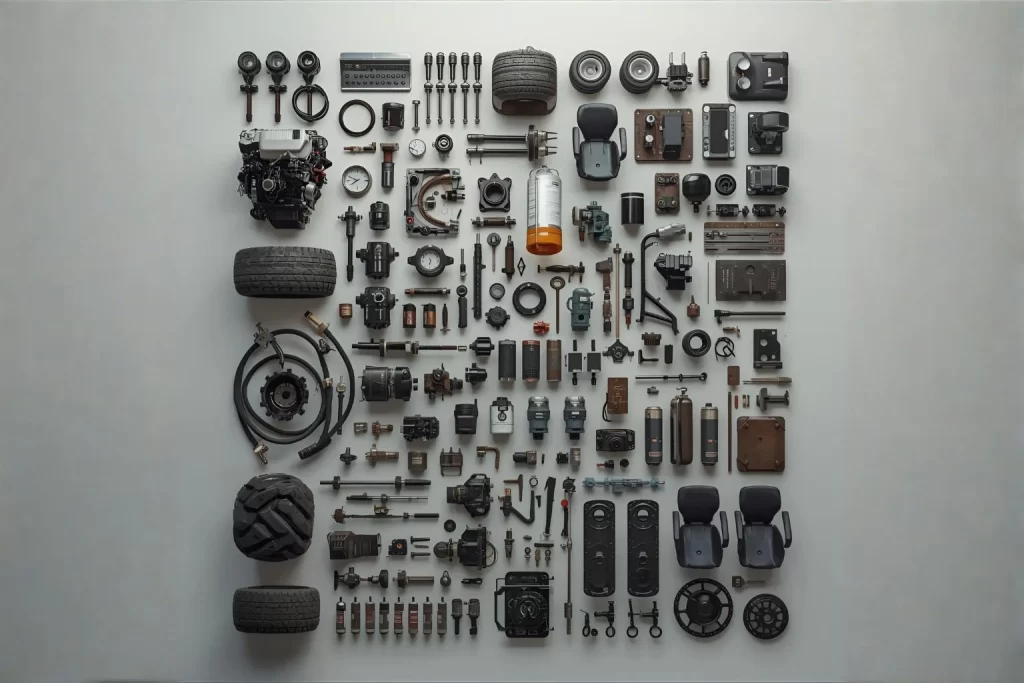
There’s a familiar sight in the countryside—a sturdy tractor, rumbling across a field, leaving perfectly tilled soil in its wake. It’s a symbol of hard work and the backbone of modern agriculture. But have you ever stopped to wonder what’s going on beneath that iconic hood and steel frame? A tractor is a masterpiece of engineering, a complex puzzle where each piece has a vital role.
Whether you’re a seasoned farmer doing pre-season maintenance, a student in ag-mechanics, or simply a curious mind, understanding the different parts of a tractor is the first step to appreciating this incredible machine. This isn’t just a dry list of components; it’s a journey into the heart of a workhorse. Let’s pop the hood, so to speak, and get to know the anatomy of the tractor.
The Beating Heart: The Tractor Engine
At the core of every tractor is its engine, the source of all its power and might. This isn’t your average car engine; it’s built for endurance and raw torque.
Diesel Power: The Unrivaled Champion
The vast majority of modern tractors run on diesel. Why? Diesel engines are more fuel-efficient, generate more torque at lower RPMs (which is essential for pulling heavy loads), and are built to last for thousands of hours. They are workhorses designed for the long haul.
Key Engine Components You Should Know:
Cylinders & Pistons: Where the magic happens. Fuel is ignited, creating controlled explosions that force the pistons down, creating rotational force.
Turbocharger: This clever device uses exhaust gases to force more air into the cylinders, significantly boosting power and efficiency without increasing engine size. It’s why modern tractors are so powerful yet relatively compact.
Air Filter & Cooling System: A tractor’s work environment is dirty. A massive, often dual-stage air filter is crucial to prevent dust from destroying the engine. The large radiator and cooling fan work tirelessly to prevent overheating during those long, hot days in the field.
The Power Translator: The Tractor Transmission
The engine creates power, but the transmission decides how that power is delivered to the wheels. It’s the command center for speed and pulling force.
Types of Tractor Transmissions:
Manual Gear Transmission: The classic. It offers a set number of gears and is known for its simplicity and durability.
Power Shift: A game-changer. This allows the operator to shift gears under full load without using the clutch, meaning no loss of power or momentum during critical tasks like plowing.
Continuously Variable Transmission (CVT): The pinnacle of tractor tech. A CVT provides an infinite number of gear ratios, automatically selecting the most efficient engine speed for the task at hand, maximizing fuel economy and performance.
The Differential and Final Drive
This is what allows the rear wheels to rotate at different speeds when turning. The final drive is the last step in reducing the engine’s high RPM to the high-torque, low-speed rotation needed to turn the massive rear wheels.
The Foundation: The Tractor Chassis and Frame
This is the tractor’s skeleton. It’s a heavy, rigid steel structure that supports every other component. There are two main types:
Standard Frame: The traditional design where the engine and transmission are bolted together.
Unibody Frame (or articulated): A more modern approach where the tractor is essentially in two halves connected by a pivot pin, allowing for incredible maneuverability.
The Muscle: Hydraulics and the Three-Point Hitch
This is where the tractor’s true versatility shines. The hydraulic system is the “muscle” that allows it to lift, lower, and power a vast array of implements.
How the Hydraulic System Works:
A hydraulic pump, driven by the engine, pushes fluid through hoses to hydraulic cylinders. This pressurized fluid moves the piston inside the cylinder, creating powerful linear motion. This is what raises the massive loader bucket or lifts a heavy plow out of the ground.
The Revolutionary Three-Point Hitch
Invented by Harry Ferguson, this is arguably one of the most important innovations in agricultural history. It’s a standardized linkage system on the rear of the tractor that allows for:
Quick Attachment of implements like plows, mowers, and seeders.
Draft Control, which automatically adjusts the depth of an implement based on soil resistance.
Weight Transfer, improving the tractor’s traction.
The Power Take-Off (PTO)
Often a spinning splined shaft at the rear (or sometimes front) of the tractor, the PTO transfers engine power directly to pulled implements. This is what spins the blades of a rotary cutter, powers the baler, or runs the pump on a sprayer. It’s like a portable engine for your field tools.
The Connectors: Tractor Tires and Wheels
Tractor tires are specialized tools, not just rubber and air. The choice of tire dramatically impacts performance.
Rear Tires: These are the giants, with deep, aggressive treads (lugs) designed to dig into the soil and provide maximum traction. They are often filled with liquid (like calcium chloride or beet juice) for extra weight and ballast.
Front Tires: Smaller and with a tighter tread pattern, they are designed primarily for steering. On 4WD tractors, the front tires are more heavy-duty to handle the added pulling force.
The Command Center: The Operator’s Platform (The Cab)
Gone are the days of the open, metal seat. The modern tractor cab is a climate-controlled, ergonomic office on wheels.
ROPS (Roll-Over Protective Structure): A reinforced frame that is absolutely critical for operator safety in the event of a rollover.
Climate Control: Air conditioning and heating make it possible to work comfortably in all conditions.
The Dashboard and Joysticks: Modern tractors feature digital displays showing everything from engine vitals to GPS guidance maps. Multifunction joysticks control the loader and hydraulics with fingertip precision, reducing fatigue.
The Essential Support Systems
These are the unsung heroes that keep the tractor running smoothly and safely.
The Electrical System: It powers everything from the starter motor and headlights to the complex computers and sensors. The battery and alternator work in tandem to keep it all running.
The Fuel System: This includes the fuel tank (which can be massive, holding over 100 gallons in some cases), filters to ensure clean diesel reaches the engine, and fuel injectors that deliver a precise mist of fuel into the cylinders.
The Braking System: Tractors use powerful, oil-cooled disc brakes, often independent for each rear wheel to assist in sharp turns. The parking brake is a robust, mechanical system to hold the machine securely on an incline.
Putting It All Together: A Symphony of Parts
Think of operating a tractor to plow a field. You start the engine, which provides the power. You select a gear in the transmission to match the soil conditions. You lower the plow using the hydraulics and connect it via the three-point hitch. As you drive, the PTO might be powering a seeder behind you. You steer comfortably from the climate-controlled cab, while the tires grip the earth and the brakes stand ready. Every single part we’ve discussed works in perfect harmony to turn fuel and human intention into productive work.
Tractor Parts FAQ: Your Questions Answered
What is the most important part of a tractor?
It’s impossible to name just one, as they are all interdependent. However, the engine is the source of power, and the hydraulics and three-point hitch are what make it uniquely versatile. Without either, it wouldn’t be a tractor.
What regular maintenance is most critical?
Check Fluid Levels: Engine oil, coolant, and hydraulic fluid are the lifeblood.
Change Filters: Regularly replace fuel, oil, and air filters. A clogged air filter is a silent engine killer.
Grease Fittings: The three-point hitch and loader joints have grease fittings (zerks) that must be lubricated frequently to prevent wear.
How have tractor parts evolved over time?
The evolution has been towards precision, comfort, and efficiency. From simple gears to CVT transmissions, from open stations to GPS-guided cabs, and from manual controls to computerized joysticks, every part has been refined to make farming more productive and less labor-intensive.
Conclusion
A tractor is far more than the sum of its parts. It’s a testament to human ingenuity, a tool that has shaped our world and fed nations. By understanding the role of the engine, transmission, hydraulics, and hitch, you gain a deeper appreciation for the engineering marvel that sits in the shed. The next time you see one, you’ll see more than just a machine; you’ll see a complex, powerful, and beautifully integrated system built for one purpose: to get the job done.
Now that you’re an expert on tractor anatomy, which part do you find the most fascinating? Do you have any tractor stories to share? Let us know in the comments below!